Math Department
Math Sequence
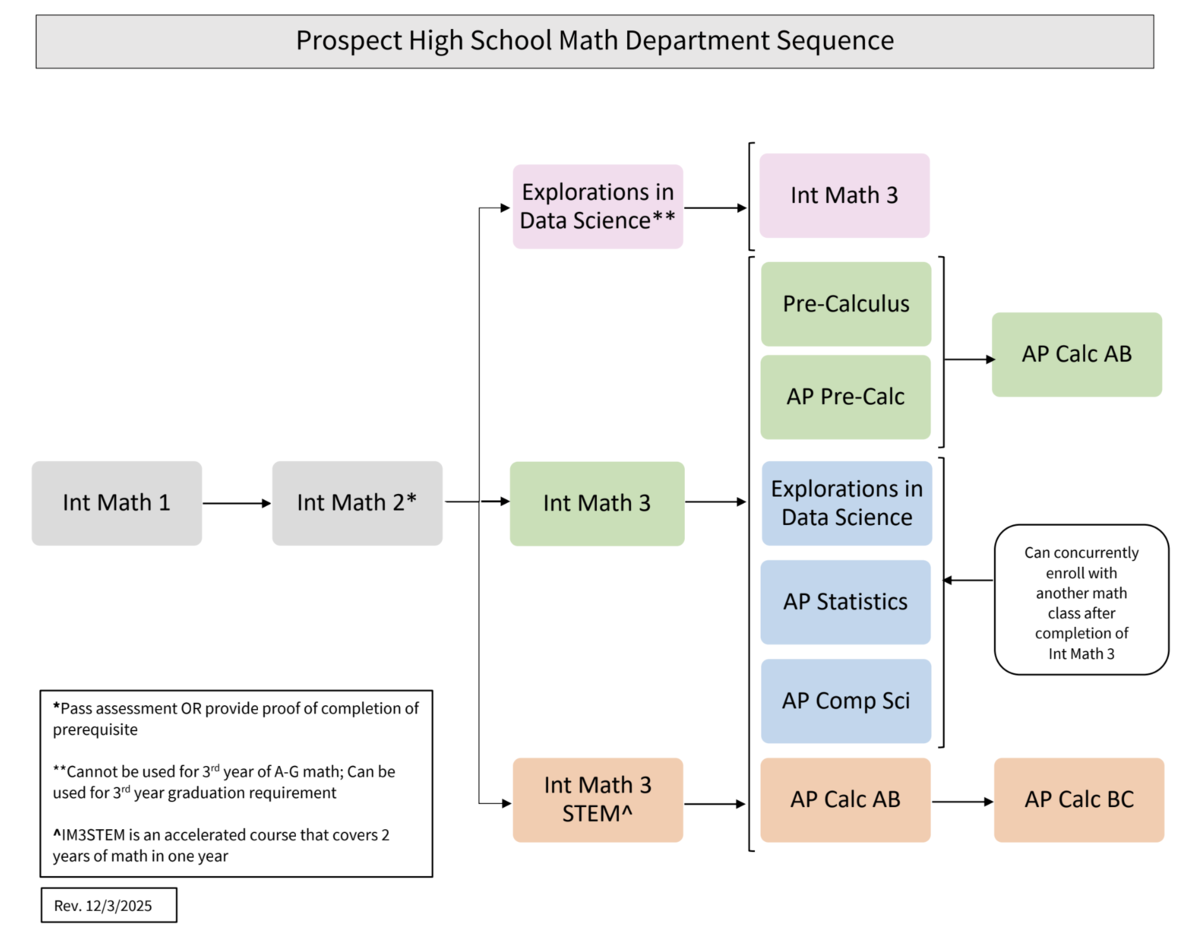
Course Descriptions
Integrated Math 1 ▼ View Details
This is a one-year college prep course that meets state graduation requirements for Algebra 1. This course includes the following topics: An overview of functions (linear, quadratic and exponential) in functional form, graphs, and tables; Linear equations and inequalities in one and two variables; Geometric constructions; Congruence and rigid motions; Geometric relationships and properties of triangles, parallel lines, quadrilaterals and circles; Analyzing and interpreting data in one and two variables.
- Graduation Credit: Mathematics
- UC/CSU Area: Math (c)
Integrated Math 2 ▼ View Details
This is a one-year college prep course that meets state graduation requirements for Geometry. This course includes the following topics: Similarity; Coordinate geometry; Trigonometric ratios; Quadratic functions; Quadratic equations; Probability.
- Prerequisite: Integrated Math 1 or Algebra 1
- Graduation Credit: Mathematics
- UC/CSU Area: Math (c)
Integrated Math 3 ▼ View Details
The following units will be covered in Integrated Math 3: Statistics (Random Processes), Circles and Conics, Trigonometric Functions, Exponential Functions, Functions Capstone, Rational and Polynomial Expressions. This course will complete the 3-year Integrated Math series and includes remaining High School Common Core Math Standards that are not covered in Integrated Math 1 and Integrated Math 2.
- Prerequisite: Integrated Math 2 or Geometry
- Graduation Credit: Mathematics
- UC/CSU Area: Math (c)
Integrated Math 3 STEM ▼ View Details
This course is designed for students who are interested in pursuing STEM fields in college. This course is an enhanced course and not an honors course and will cover topics above the Integrated Math 3 course, including vectors, complex numbers and advanced trigonometric function analysis. The following units will be covered in Integrated Math 3 STEM: Statistics (Random Processes), Circles and Conics, Trigonometric Functions, Vectors, Exponential Functions, Functions Capstone, Rational and Polynomial Expressions. This course will complete the 3-year Integrated Math series and includes the remaining High School Common Core Math Standards and a variety of the "plus" standards that are not covered in Integrated Math 1 and Integrated Math 2.
- Prerequisite: Integrated Math 2 or Geometry
- Graduation Credit: Mathematics
- UC/CSU Area: Math (c)
Explorations in Data Science ▼ View Details
In this course students will learn to understand, ask questions of, and represent data through project-based units. The units will give students opportunities to be data explorers through active engagement, developing their understanding of data analysis, sampling, correlation/causation, bias and uncertainty, modeling with data, making and evaluating data-based arguments, and the importance of data in society. At the end of the course, students will have a portfolio of their data science work to showcase their newly developed knowledge and understanding.
- Prerequisite: Integrated Math 2
- Graduation Credit: Mathematics
- UC/CSU Area: Math (c); College Prep Electives (g)
Pre-Calculus ▼ View Details
This is a one-year college prep course that extends the Integrated Mathematics series. The course will include a deeper exploration of trigonometric, rational, piecewise, exponential and logarithmic functions. Students will explore applications of complex numbers and vectors as well as broaden their understanding of statistical regression and probability.
- Prerequisite: Integrated Math 3 or Integrated Math 3 STEM
- Graduation Credit: Mathematics
- UC/CSU Area: Math (c); College Prep Electives (g)
AP Pre-Calculus ▼ View Details
AP Pre-Calculus provides students an opportunity to take the rigor of an AP class while also providing an opportunity to strengthen their precalculus skills, algebraic fluency, and conceptual thinking and understanding before taking AP Calculus AB. This course will be appropriate to both students coming from IM3 and IM3 STEM.
- Prerequisite: Integrated Math 3 or Integrated Math 3 STEM
- Graduation Credit: Mathematics
- UC/CSU Area: Math (c); College Prep Electives (g)
- Honors/AP Value: UC/CSU Weighted
AP Calculus AB ▼ View Details
Calculus AB is primarily concerned with developing the students’ understanding of the concepts of calculus and providing experience with its methods and applications. The course emphasizes a multirepresentational approach to calculus, with concepts, results, and problems being expressed graphically, numerically, analytically, and verbally. The connections among these representations also are important.
- Prerequisite: Integrated Math 3 STEM or Pre-Calculus/Integrated Math 4
- Graduation Credit: Mathematics
- UC/CSU Area: Math (c); College Prep Electives (g)
- Honors/AP Value: UC/CSU Weighted
AP Calculus BC ▼ View Details
Calculus BC is an extension of Calculus AB rather than an enhancement; common topics require a similar depth of understanding. Both courses are intended to be challenging and demanding. Broad concepts and widely applicable methods are emphasized. In addition to the topics covered in Calculus AB, students in Calculus BC learn advanced integration techniques and analyze polar, parametric, and vector functions. Calculus BC also includes the study of power series and various methods to determine convergence or divergence of a series. Students become familiar with Maclaurin series for common functions and general Taylor series representations. Additional topics include the radius and interval of convergence and operations on power series.
- Prerequisite: AP Calculus AB
- Graduation Credit: Mathematics
- UC/CSU Area: Math (c); College Prep Electives (g)
- Honors/AP Value: UC/CSU Weighted
AP Statistics ▼ View Details
The AP Statistics course lends itself naturally to a mode of teaching that engages students in constructing their own knowledge. For example, students working individually or in small groups can plan and perform data collection and analyses where the teacher serves in the role of a consultant, rather than a director. This approach gives students ample opportunity to think through problems, make decisions and share questions and conclusions with other students as well as with the teacher. Important components of the course should include the use of technology, projects and laboratories, cooperative group problem-solving, and writing, as a part of concept-oriented instruction and assessment. This approach to teaching AP Statistics will allow students to build interdisciplinary connections with other subjects and with their world outside school.
- Prerequisite: Integrated Math 3 or Integrated Math 3 STEM
- Graduation Credit: Mathematics
- UC/CSU Area: Math (c); College Prep Electives (g)
- Honors/AP Value: UC/CSU Weighted
AP Computer Science ▼ View Details
The AP Computer Science course is an introductory course in computer science. Because the design and implementation of computer programs to solve problems involve skills that are fundamental to the study of computer science, a large part of the course is built around the development of computer programs that correctly solve a given problem. These programs should be understandable, adaptable, and, when appropriate, reusable. At the same time, the design and implementation of computer programs is used as a context for introducing other important aspects of computer science, including the development and analysis of algorithms, the development and use of fundamental data structures, the study of standard algorithms and typical applications, and the use of logic and formal methods.
- Prerequisite: Integrated Math 3, Integrated Math 3 STEM, or Algebra 2, AND Computer Programming
- Graduation Credit: Mathematics, Applied Arts, Career Technical Education (CTE)
- UC/CSU Area: College Prep Electives (g)
- Honors/AP Value: UC/CSU Weighted
Staff



Additional Math Resources
CUHSD uses College Prep Math for their textbook. Below are additional resources including Homework Help, Parent Guide with Extra Practices, eTool, and more.